Ophthalmic asset diligence
Could your existing lead candidate become a valuable ophthalmic asset?
We assess whether your drug, biologic or lead candidate has a credible route into ophthalmology, from discovery to an IND-ready plan, before you spend heavily on development.
How the engagement runs
Three tracks, with a decision after each. Stopping early is a valid outcome, and usually the cheapest one. We use software to search the literature faster, but the recommendation is ours.
Is the eye a credible target?
- Matching your mechanism to eye diseases it could treat
- Literature review and computational assessment
- Whether the drug can reach the target tissue in the eye
- A first read of the patent landscape
You get: a shortlist of indications, an evidence matrix, a risk register and a recommendation memo.
Prove it
- A plan for the safety, toxicology and efficacy studies
- Endpoints and acceptance criteria
- Writing the CRO brief, choosing the provider, overseeing the work
Who does what: we design the studies and oversee them. They run at CROs you contract directly.
Defend it
- IP strategy with your patent attorney
- A valuation model with every assumption written down
- Materials for investors and partners
Who does what: formal freedom-to-operate opinions and filings come from a qualified patent attorney, not from us.
A decision you can defend
Where we sit
You hold one relationship, not five. We design the evidence, brief and oversee the laboratories that generate it, build the patent position with your attorney, and hand back something your board can decide on.
- YouBring the candidate and the question behind it. You hold one relationship, and you contract the laboratories directly so the costs stay yours.
- We design the evidence planWhich studies, in which order, with the endpoints and acceptance criteria set before anything runs.
- We brief and oversee the CROsWe write the brief, choose the provider and manage the work. The studies run at CROs you contract; the raw data comes back to us to analyse.
- We build the patent positionStrategy with your patent attorney, who issues the formal opinions and makes the filings. We do not do that part, and we say so upfront.
- You get one decision packageAn indication shortlist, the evidence matrix, the risk register and a recommendation. Not a folder of files for you to interpret.
How the engagement works
The first paid stepOphthalmic opportunity assessment
- For
- A biotech with a candidate or a mechanism in hand, considering an eye disease.
- You send
- A non-confidential summary to start. Data under a confidentiality agreement once we agree to proceed.
- We do
- We match your mechanism to the eye diseases it could treat, review the literature and run a computational assessment, work out whether the drug can reach the target tissue, and set out where it differs from what already exists.
- You get
- An indication shortlist, evidence matrix, risk register, recommendation memo and a readout meeting.
- Decision
- Proceed, pause until a named piece of evidence is in, or stop.
- Fee
- Fixed scope and fee, agreed before work starts.
- Not included
- Experimental results, formal patent opinions, or any guaranteed regulatory outcome.
Thirty minutes, no charge
No obligation either. Tell us the asset and the question, and we’ll say whether a Track 1 is worth doing. Sometimes it isn’t.
Stop after any track
No retainer, no minimum term, no notice period. Track 1 is a fixed fee agreed upfront; Tracks 2 and 3 are scoped only if you go ahead. CRO costs are quoted to you directly and passed through at cost. We don’t mark up lab work.
A handful of assets at a time
We work on a small number of assets at once. If we can’t give yours proper attention, we’ll say so rather than take it on.
Where to start
Send us a few details through the form. The first call is free and commits you to nothing, and half an hour is usually enough for a useful first read.
Pricing on request. Tell us the asset, the stage and the question, and we’ll send back a Track 1 scope with a fixed quote.
If the decision is go
We can also help you carry it out.
After the assessment, we can design the validating studies and match you with specialist CROs. For organisations building ophthalmic capability in-house, we can set up disease modelling, imaging, molecular and analytics workflows on the infrastructure you already have.
References
The figures we quote, and where they come from. Industry forecasts are third-party projections; the peer-reviewed analyses below are the primary evidence.
- Wong CH, Siah KW, Lo AW. Estimation of clinical trial success rates and related parameters. Biostatistics 2019;20(2):273–286. doi:10.1093/biostatistics/kxx069. From 406,038 trial records: ophthalmology moved from Phase 1 to Phase 2 in 87.1% of trials against 66.4% across all areas, and the overall probability of success from Phase 1 to approval was 32.6% against 13.8%.
- BIO, Informa Pharma Intelligence and QLS Advisors. Clinical Development Success Rates and Contributing Factors 2011–2020 (February 2021), Figure 2. Phase I transition success by disease area: 71.6% in ophthalmology against 52.0% across all indications.
- Michaeli DT, Yagmur HB, Achmadeev T, Michaeli T. Valuation and Returns of Drug Development Companies: Lessons for Bioentrepreneurs and Investors. Therapeutic Innovation & Regulatory Science 2022;56(2):313–322. doi:10.1007/s43441-021-00364-y. Across 311 acquisitions from 2005 to 2020, equity in companies with multi-indication lead drugs returned a 2.9x investment multiple from pre-clinic to approval against 1.7x for single-indication drugs, or 21% a year against 11%.
- Michaeli DT, Yagmur HB, Achmadeev T, Michaeli T. Value drivers of development stage biopharma companies. European Journal of Health Economics 2022;23(8):1287–1296. doi:10.1007/s10198-021-01427-5. Acquirers paid a 12% premium per additional indication, and 37% more for biologic and gene therapy lead drugs than for small molecules.
- IQVIA Institute. Emerging Biopharma’s Contribution to Innovation (2022). Share of novel active substances originated outside large pharma, 2012 to 2021.
- Merck & Co. “Merck to Acquire EyeBio”, 29 May 2024. US$1.3B paid upfront, with the lead candidate in early clinical development.
- Cheng H, et al. Ophthalmic drug discovery and development using artificial intelligence and digital health technologies. npj Digital Medicine 2025;8, 25 September 2025. Ophthalmic market projection and early-stage development time.
Reference 1 reports clinical-phase transitions across all sponsors from 2000 to 2015; reference 2 covers 2011 to 2020 on a different dataset and method. Both are historical industry comparisons and neither forecasts the outcome of any individual candidate. Reference 3 models returns from acquisition values combined with published success rates, and its ophthalmology data sit within a combined “other” disease category.
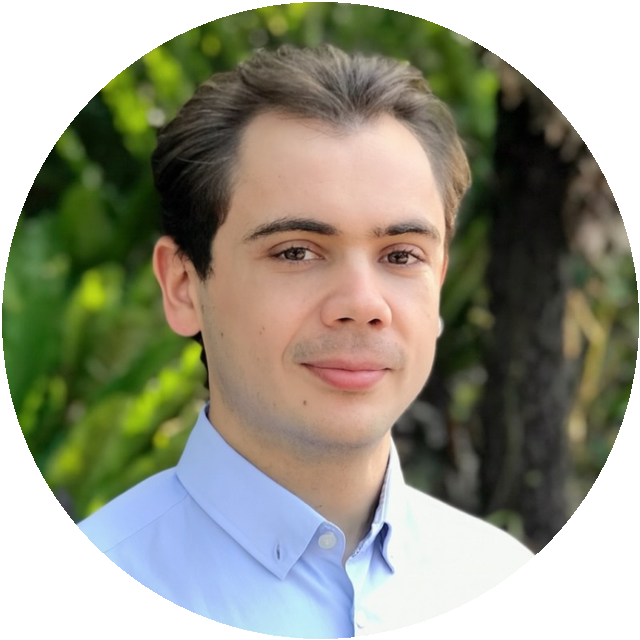
Managing Director & Founder
Dr. Adrian Cioanca
You deal with me from the first call to the final readout. I have built ophthalmic disease models for a global pharmaceutical company, raised capital on the kind of valuation model I now build for clients, and sat on the founder side of the table when the evidence had to convince someone else.
- PhD in retinal degeneration and bioinformatics; University Medal and the Frank Fenner Medal for the thesis
- Led a retinal research team; 28 peer-reviewed papers
- Co-founded a retinal therapeutics company: discovered the lead, secured the IP, raised the funding for safety and toxicology
- Built disease models and testing pipelines for small and large biotech, supporting client patents and US$3M in investment and grants
- Data and AI at a top global consulting firm, across government, energy and retail
Evaluate your candidate.
Tell us about your asset, and we’ll tell you whether the eye looks like a credible opportunity for it.
Get in touch → Book a free introductory call →adrian@tractumbio.com
The form takes a minute: the asset, its stage and the question you are trying to answer. Keep it non-confidential for now. The first call is thirty minutes, no charge and nothing locked in. We reply within two business days.